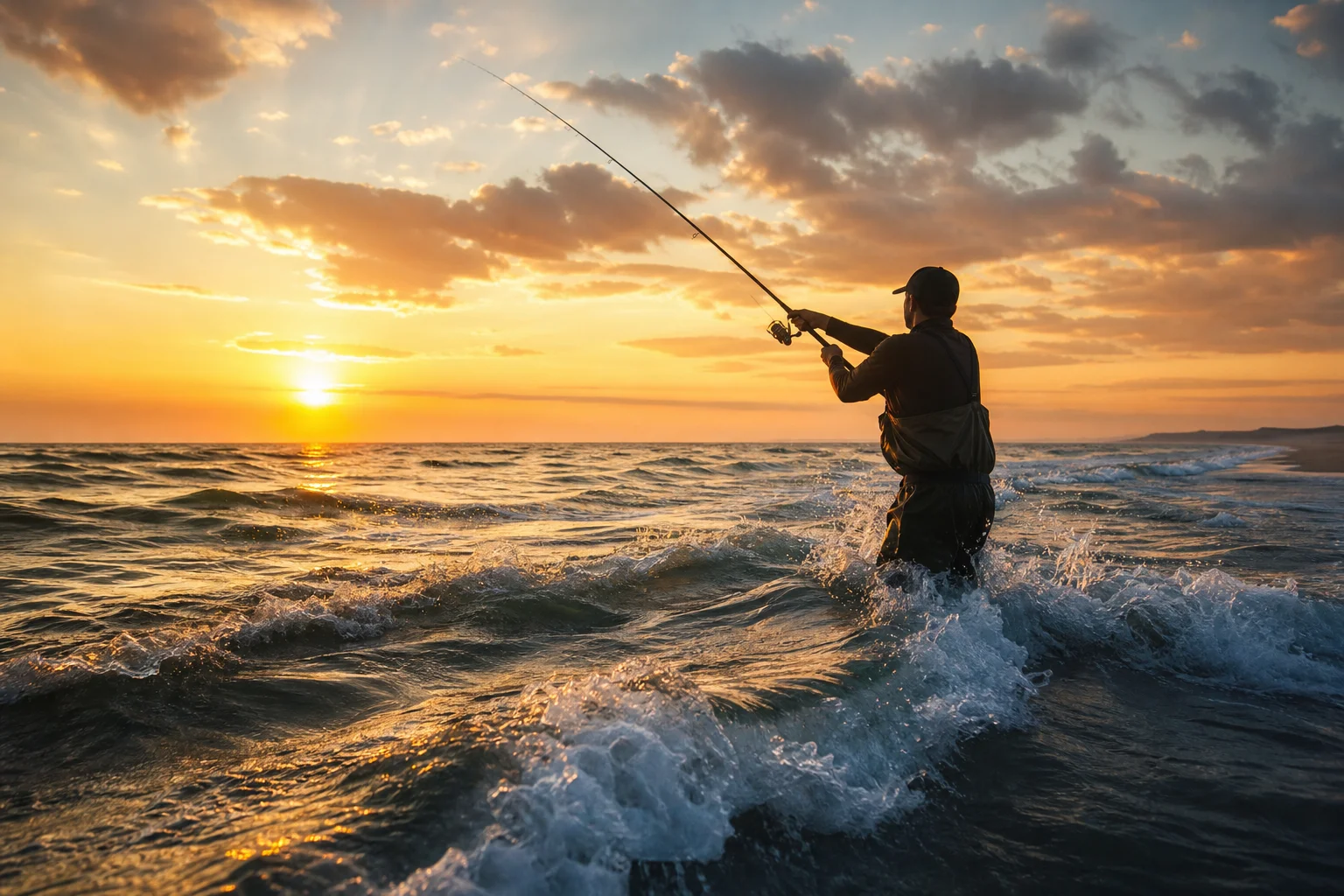
Saltwater Fish Attractant Tactics For Surf And Inshore
Tide and surf dilute scent fast, but saltwater species are among the best chemical hunters in fishing. Here is how to time a scent trail with the tide, fish the surf zone, and treat baits for redfish, trout and flounder.
Salt water is a harder environment for scent than fresh, and it is worth saying so plainly. Tidal current moves water constantly, wave action in the surf zone churns and dilutes, and the volume you are fishing is enormous compared with a lake.
But saltwater species are also, as a group, exceptionally good at chemical detection. Sharks, redfish, striped bass and most bottom-feeding species locate food by smell routinely, and inshore fish spend much of their lives hunting in water stained by tide and sediment. The opportunity is real. It just requires working with the water rather than ignoring it.
Work With The Tide, Not Against It
Everything in saltwater scent fishing starts here. Moving water is not the enemy of a scent trail — it is the delivery system. Your job is to know where your trail is going and to put it in front of fish.
Fish the outgoing at a cut or creek mouth
An outgoing tide draining a marsh, creek or backwater is a conveyor belt. Bait gets flushed out, predators stack at the mouth facing into the flow, and everything they eat comes to them. Position above the ambush point and let your scent trail run down to them. This is the single highest-percentage saltwater scent scenario there is.
Fish the incoming over flats and structure
A rising tide pushes fish up onto flats, oyster bars and sand bars to feed. Set your bait where the new water is arriving and let the trail spread into the area they are moving into.
Slack tide is the weak window
No current, no trail — just a slowly expanding cloud. Slack is when you rely on placement and patience rather than on scent doing any searching for you.
Surf Fishing
The surf zone is turbulent, and a lot of product simply washes off. Adjust for that rather than fighting it.
- Concentrate on baits that hold. Cut mullet, bunker chunks, sand fleas and shrimp all carry and hold scent well. Hard lures in the surf are nearly a lost cause for scent — treat your hands instead.
- Work product into the cut face. On chunk bait, the exposed flesh is where scent bonds and where the natural oils are already leaking.
- Refresh every retrieve. Every time the bait comes back through the breakers it has been scrubbed. Re-treat before every cast — no exceptions in the surf.
- Fish the troughs and cuts. Read the beach at low tide and note where the deeper troughs and rip cuts are. Those are the travel lanes, and a trail placed in one gets found. A trail on a flat sandbar goes nowhere.
- Use enough weight to stay put. A bait rolling down the beach smears its trail across a hundred yards of water instead of concentrating it where fish are moving.
Inshore — Redfish, Trout And Flounder
This is where saltwater scent fishing is most productive, because inshore water is often stained and inshore presentations are often slow.
Redfish
Reds root along the bottom and in muddy backwater where they frequently cannot see well. They are strongly scent-oriented — which is exactly why cut bait on the bottom is such a reliable redfish tactic. When fishing soft plastics on a jig head for reds, treat the bait properly and fish it slowly along the bottom. In dirty marsh water, this is often the difference between a slow day and a good one.
Speckled trout
More visual than reds and more willing to chase, so scent matters less on a fast-worked topwater or twitch bait. It matters considerably on a slow-drifted popping cork rig or a jig worked deliberately in deeper holes during winter, when trout go slow and stay near the bottom. Treat the plastic, and re-treat every ten casts.
Flounder
An ambush predator that sits buried and waits, then takes the bait and holds it before turning it. Long hold time is the whole game — the traditional advice to wait before setting the hook exists because of it. A bait that tastes right gets held through that pause instead of dropped. Treat every jig and every strip bait.
Sheepshead, black drum and bottom species
Structure-oriented, cautious, and famous for stealing bait. Scent helps mainly by encouraging a longer, more committed bite from a fish that would otherwise pick at the edges.
Bay And Nearshore Bottom Fishing
Anchored over structure with cut bait on the bottom is a plume scenario, exactly like catfishing in a river. Set up uptide of the structure so the trail sweeps across it, refresh baits every 20 to 30 minutes, and expect fish to arrive from downtide. If you are chumming, a treated hook bait keeps its own signature inside the chum slick rather than disappearing into it.
What Salt Water Demands From A Product
It must cling hard. This is non-negotiable. Between tidal flow, wave action and long soaks, a thin liquid attractant is gone almost immediately. A gel that bonds to the bait surface and releases gradually is the only formulation that makes sense in salt.
It must actually be rated for salt water. Plenty of scent products are formulated around freshwater forage profiles. Check that the product is intended for both.
It should be biodegradable. You are fishing estuaries, marshes and nursery habitat. Use something that breaks down.
Legacy Strike 75 is formulated for fresh and salt water in the same bottle — an all-natural, biodegradable cling gel on a 75-year-old trigger formula — which is genuinely useful when a single trip covers a marsh creek in the morning and a beach in the afternoon.
Practical Rules For A Salt Day
- Check the tide chart before anything else and plan around moving water.
- Set up so your trail runs toward the fish, never away from them.
- Refresh every cast in the surf, every 20 to 30 minutes on a bottom soak.
- Treat cut faces and strip baits, not smooth hard lures.
- Slow down in stained water and let scent carry more of the work.
- Rinse your gear afterward — salt is harder on tackle than anything else you will do.
Salt water asks more of a scent product and more of the angler using it. Time it with the tide and keep it on the bait, and it holds up. For the full application breakdown across bait types, see how to use fish attractant on every lure you own.
Written by Legacy Strike 75