Do Fish Attractants Really Work
Fish attractants are either the best-kept secret in fishing or expensive snake oil, depending on who you ask. Here is what scent genuinely does underwater, what it cannot do, and how to run a fair test on your own water.
It is the fairest question in the tackle aisle. Scent products have been sold for decades, the marketing has never been shy, and every angler has a friend who swears by a bottle and another who calls the whole category snake oil.
The honest answer sits between those two positions, and it is more useful than either. Attractants do something real. They also do not do the thing most packaging implies. Understanding the difference is what turns a bottle from a gimmick into a tool.
Fish Live In A Chemical World
Start with the biology, because that part is not controversial. Fish have well-developed chemoreception — both smell and taste — and in many species it is a primary sense rather than a backup.
Water carries dissolved compounds efficiently, and a fish's nares are constantly sampling that flow. Catfish are the extreme case: they carry taste receptors across much of their skin, not just in the mouth, which is why a catfish can locate bait in water where seeing anything is impossible. Sharks and many saltwater species track dilute chemical signals over long distances. Bass, walleye and panfish are less scent-dominant than catfish, but they still smell and taste continuously — and crucially, they use it at the moment of the eat.
So the premise is sound. Fish detect what is in the water. The real question is what a small amount of product on a moving lure can realistically accomplish.
What Attractants Genuinely Do
They remove things that push fish away
This is the least glamorous benefit and probably the most reliable one. Human hands carry sunscreen, insect repellent, fuel, oil, tobacco, soap and sanitizer. Several of these are known to be detectable and off-putting to fish. A scent product that covers those compounds is doing measurable work even if it never "attracts" anything — it is removing a negative rather than adding a positive.
They extend how long a fish holds the bait
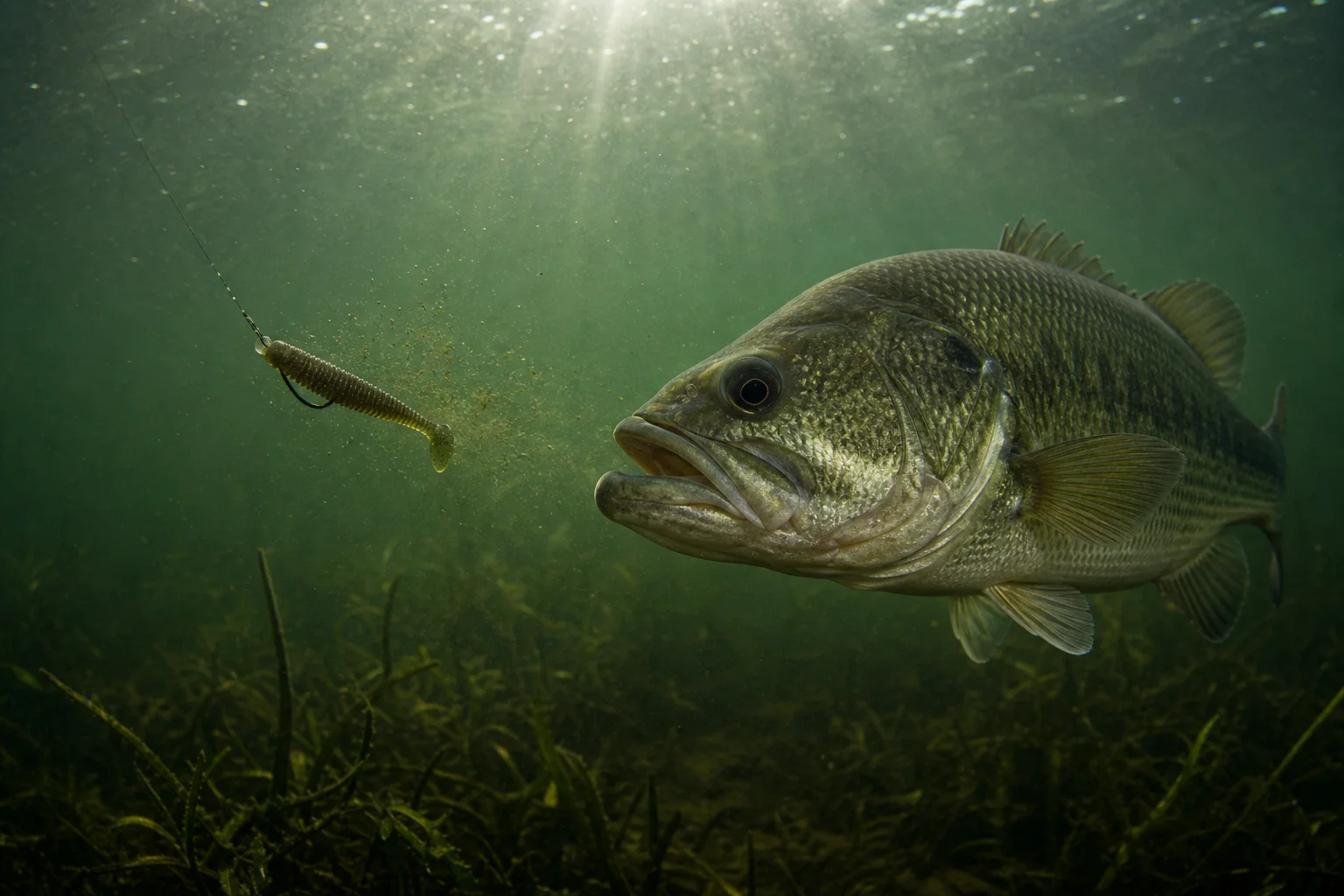
This is where scent puts fish on the deck. A bass that takes a plastic worm and tastes only plastic and salt rejects it fast — often faster than a distracted angler can react. A bait that reads as food gets held longer. On bottom presentations where you detect the bite by feel rather than by sight, an extra fraction of a second is the whole ballgame.
Anglers describe this without naming it whenever they say a fish "ate it and hung on" or "didn't spit it." That is the mechanism at work.
They matter more as visibility drops
In clear water on a bright day, a fish hunting a moving bait is using its eyes. In stained water, at night, under heavy algae, or 25 feet down, it leans on smell and lateral line instead. Scent's contribution scales up exactly as sight scales down. This is why the most consistent scent believers tend to be catfish anglers, night fishermen and people working dirty rivers — they fish in the conditions where scent carries the most weight.
What Attractants Do Not Do
Being straight about the limits is what makes the rest credible.
- They do not summon fish from across the lake. A small quantity of product on a lure disperses into an enormous volume of water. On a moving bait it barely forms a trail at all. Anything advertising long-range pulling power is overselling.
- They do not fix bad location. No chemical creates fish where there are none. Scent is a conversion tool, not a search tool.
- They do not save a bad presentation. Wrong depth, wrong speed, wrong size, spooked fish in clear water — scent does not repair any of those.
- They do very little on fast reaction baits. A burned spinnerbait or a ripped lipless crank triggers on flash and vibration. The bait is past the fish before scent is relevant. The exception is the eat itself, when the fish clamps down and tastes something.
Scent is a closer, not a magnet. It rarely finds fish for you. It reliably keeps the ones that found you from letting go.
Why Results Feel Inconsistent
Most anglers who conclude scent "does nothing" have run an unintentionally poor test.
They applied it once at 6 a.m. and never again, so it was gone by the second hour. They used it on treble-hook hard baits where it sheets off instantly. They fished a fast-moving presentation where hold time is irrelevant. Or they used so much that it ran off the bait and coated their hands, their rod and the deck instead.
The variable that most separates people who rate attractants highly from those who dismiss them is not the brand. It is reapplication discipline and bait choice. Anglers who reapply on a schedule and use scent on soft plastics, jigs and hair almost always rate it higher than anglers who dose once and fish trebles all day. If you want the full breakdown, our guide on how to use fish attractant on every lure you own covers application by bait category.
Formula Matters More Than Marketing
Two things separate a product that performs from one that does not.
Whether it stays on the bait
A thin liquid sheets off during the cast and the first few feet of retrieve. Whatever it was made of stops mattering the moment it is no longer on the lure. A cling-style gel bonds to the bait surface and releases gradually, which is why gels routinely outlast liquids by a wide margin in real fishing. This is the single most practical difference between products, and it is rarely what the label leads with.
Whether the ingredients read as food
Amino acids, oils and organic compounds derived from actual forage read as food to a feeding fish. Purely synthetic fragrances built to appeal to a human nose in the store aisle do not carry the same signal. All-natural formulas also have a practical advantage: they are biodegradable, so you are not introducing something persistent into the water you fish.
Legacy Strike 75 was built around both of those points — an all-natural, biodegradable formula in a cling gel carrier, based on a trigger recipe refined over 75 years, and formulated to work across species in fresh and salt water.
How To Test It Yourself
Do not take anyone's word for it, including ours. Run a fair test:
- Fish two identical rods. Same rod, line, weight and bait — one treated, one clean.
- Pick the right conditions. A slow bite, stained water or a bottom presentation. That is where the mechanism should show up.
- Alternate casts to the same water so you are not comparing two different spots.
- Count hold time, not just hookups. Note how often a fish takes it and stays on versus lets go immediately. That is the metric scent should move.
- Reapply the treated bait every ten casts so you are testing scent rather than testing a bait that ran out of it.
- Give it several trips. One session is noise. Patterns show up over time.
The Verdict
Fish attractants work — within a well-defined lane. They mask what should not be in the water, they buy you longer hold time on the bite, and they contribute most when visibility is poor and the presentation is slow. They do not call fish across a lake and they do not rescue a bad day.
Judged against the marketing on some bottles, that sounds like a downgrade. Judged against what actually decides a day on the water, it is not. Slow bites, bottom baits and stained water are where seasons are made — and that is exactly the ground scent covers.
Written by Legacy Strike 75