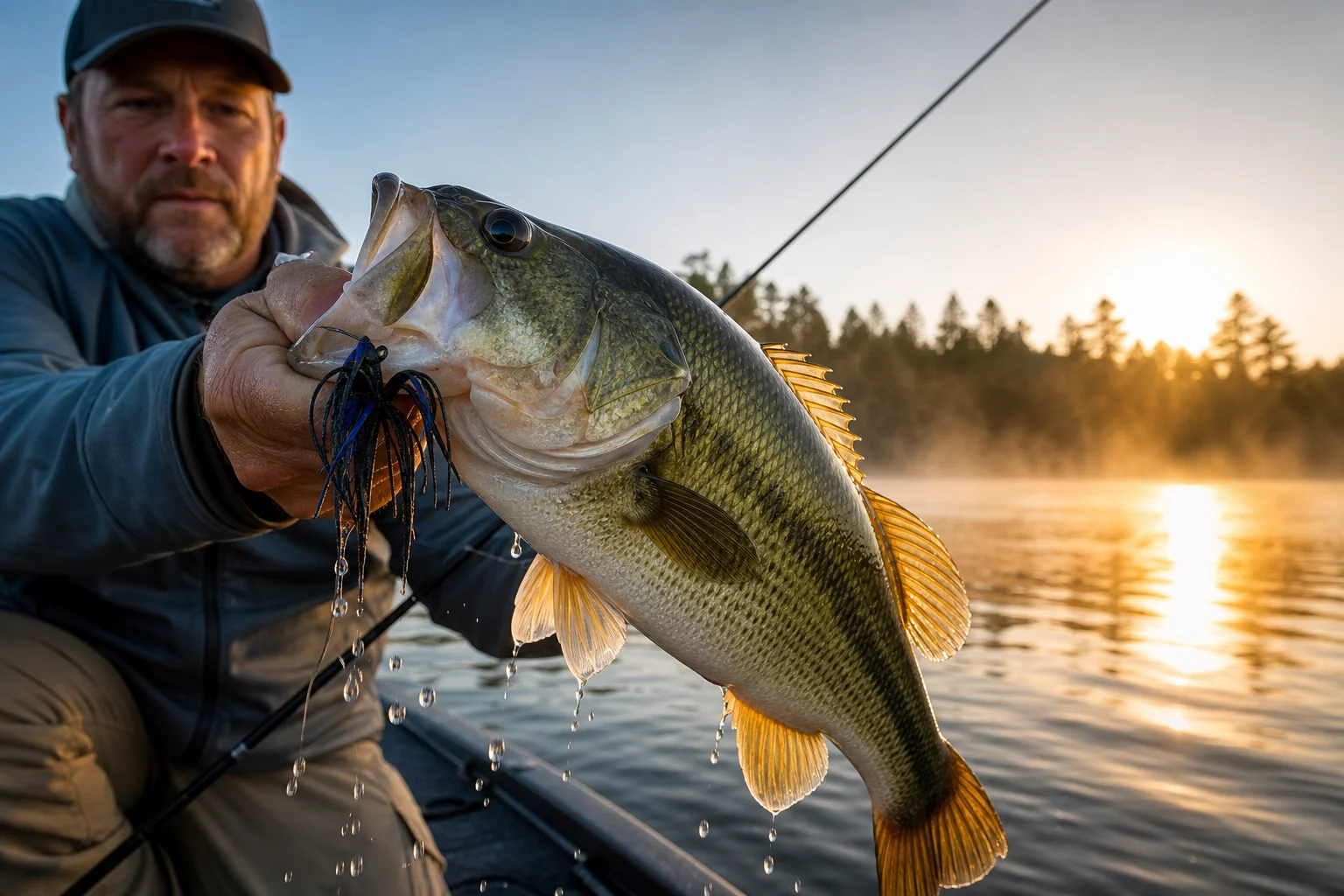
The Best Fish Attractant Setup For Largemouth Bass
Bass hunt with their eyes — until the bait is in their mouth. Here is where scent genuinely moves the needle in bass fishing, which presentations to treat, how to load a jig skirt, and how to adjust for stained, cold and post-frontal water.
Bass are visual predators first. In clear water, on a bright day, they hunt with their eyes and commit on flash, silhouette and movement. That fact leads a lot of anglers to write scent off entirely for bass fishing.
It is the wrong conclusion, because it ignores where bass fishing is actually won. Tournament weights and personal bests come disproportionately from slow bottom presentations in stained water, from flipping heavy cover, and from cold-water days when nothing wants to chase. Those are precisely the situations where a bass takes a bait into its mouth and decides — in well under a second — whether to hold it or blow it out.
That decision is a taste decision. Here is how to set up for it.
Where Scent Earns Its Keep With Bass
Rank your presentations honestly and the picture gets clear fast.
High value — treat every bait, every time
- Texas-rigged worms and creature baits. The classic hold-time scenario. You feel weight, you wait, you set. Every extra half-second helps.
- Flipping and pitching jigs. Fish eat on the fall in heavy cover and often sit with the bait sideways before you feel anything.
- Shaky heads, Ned rigs and finesse worms. Slow, on the bottom, in front of pressured fish that inspect before eating.
- Wacky and Neko rigs. Deadsticked for long stretches — maximum contact time with a fish's chemical senses.
- Carolina rigs. Dragged slowly across bottom, leaving a genuine trail behind a slow-moving bait.
Moderate value — worth doing on the trailer
- Chatterbaits and spinnerbaits. Treat the trailer and the skirt band. The eat is a reaction, but the hold still matters.
- Swimbaits. Especially soft-bodied paddle tails worked slowly on a deeper line.
- Suspending jerkbaits in cold water. Long pauses give scent time to matter, and cold-water fish often mouth it rather than crush it.
Low value — do it for the hands, not the bait
- Topwater, buzzbaits, burned lipless cranks and squarebills. The strike is reactive and instantaneous. Use scent here mainly so your sunscreen is not on the lure.
The Setup That Works
Pre-treat the bags before you launch
Do this at home or in the truck. Squeeze a line of attractant into each soft plastic bag, seal it, and knead until every bait is coated. Ribbed worms, craws and creature baits hold product in their texture and come out of the bag ready to fish. You stop losing thirty seconds per rebait, which over a full day is real fishing time.
The bags stay treated between trips too, so the salt-heavy plastics that leach fastest are always covered.
Load the skirt, not just the trailer
The most overlooked move in bass fishing. When you rig a jig, apply attractant to the trailer, then push a small amount up into the base of the skirt where the strands are collared. Living rubber and silicone hold product against the head and release it as the skirt pulses on the fall. On a flipping bite where fish eat on slack line in thick cover, that is the exact window you want covered.
Match your reapplication to the retrieve
- Deadstick presentations — wacky rig, Neko, dropshot on a long pause: every rebait and every fish.
- Dragging and hopping — Texas rig, Carolina rig, shaky head: every 10 to 15 casts.
- Flipping heavy cover: every time you pull free of a snag, because the bait scraped clean on the way through.
- Moving baits: every rebait or trailer swap.
Manage your hands
Sunscreen is the standard bass-fishing scent problem. You apply it at the ramp, then handle every bait you touch for the rest of the day. Put a small amount of attractant on your palms after sunscreen, after fueling, and after lunch. Everything you touch downstream of that carries the right signal instead of the wrong one.
Reading The Conditions
Scent should scale with how much the fish is relying on its nose.
Stained and muddy water — go heavy
Visibility under a foot means bass are hunting with lateral line and chemical senses. Slow down, fish something with a wide profile and heavy thump, keep it treated, and reapply aggressively. This is where scent contributes most in bass fishing.
Cold water below 50 degrees — go slow and treated
Cold bass do not chase and they do not crush. They mouth a bait and hold it lightly. Deadsticked jerkbaits, slow-dragged jigs and finesse plastics all benefit, because the fish has time to make a taste decision and you need it to make the right one.
Post-frontal bluebird days — treat everything
High pressure after a front pushes bass tight to cover and shuts down the chase. The bite becomes a slow, close-range, inspect-then-eat affair. That is scent's home field.
Heavily pressured fisheries — treat everything
Fish that see hundreds of baits a season inspect longer before committing. More inspection time means more chances for a wrong signal to end the bite early.
Clear water, warm, active fish — least important
Bright day, gin-clear water, fish chasing shad on a point: they are eating with their eyes and the bait is moving fast. Fish it clean, keep scent on your hands, and do not overthink it.
Choosing A Product For Bass
Two things matter more than anything on the label.
It has to stay on the bait. Bass fishing is a lot of casts. A thin liquid is gone in three. A cling-style gel bonds and releases slowly, which is the difference between a bait that is treated on cast fifteen and one that has been bare plastic since cast four.
It has to read as food. Natural, forage-derived compounds carry a food signal. Synthetic fragrances designed to smell appealing on a store shelf do not. A biodegradable formula is also simply better practice on water you intend to fish again.
Legacy Strike 75 is an all-natural cling gel built on a 75-year-old trigger formula, and it works across species — which matters when the same treated jig catches a bass on one cast and a walleye on the next.
A Simple Day Plan
- Pre-treat every soft plastic bag before you leave.
- Apply sunscreen at the ramp, then wipe your palms with attractant.
- Load the skirt and the trailer on every jig you tie on.
- Reapply every time you retie or check your line for nicks.
- Re-treat immediately after every fish and every snag.
- When the water is dirty, cold or post-frontal, slow down and double the attention to scent.
None of this replaces finding fish. It makes the fish you find convert at a higher rate — and on the slow days that decide most seasons, that is the whole margin.
For application technique across every bait category, see our guide on how to use fish attractant on every lure you own, and for the underlying mechanism read do fish attractants really work.
Written by Legacy Strike 75