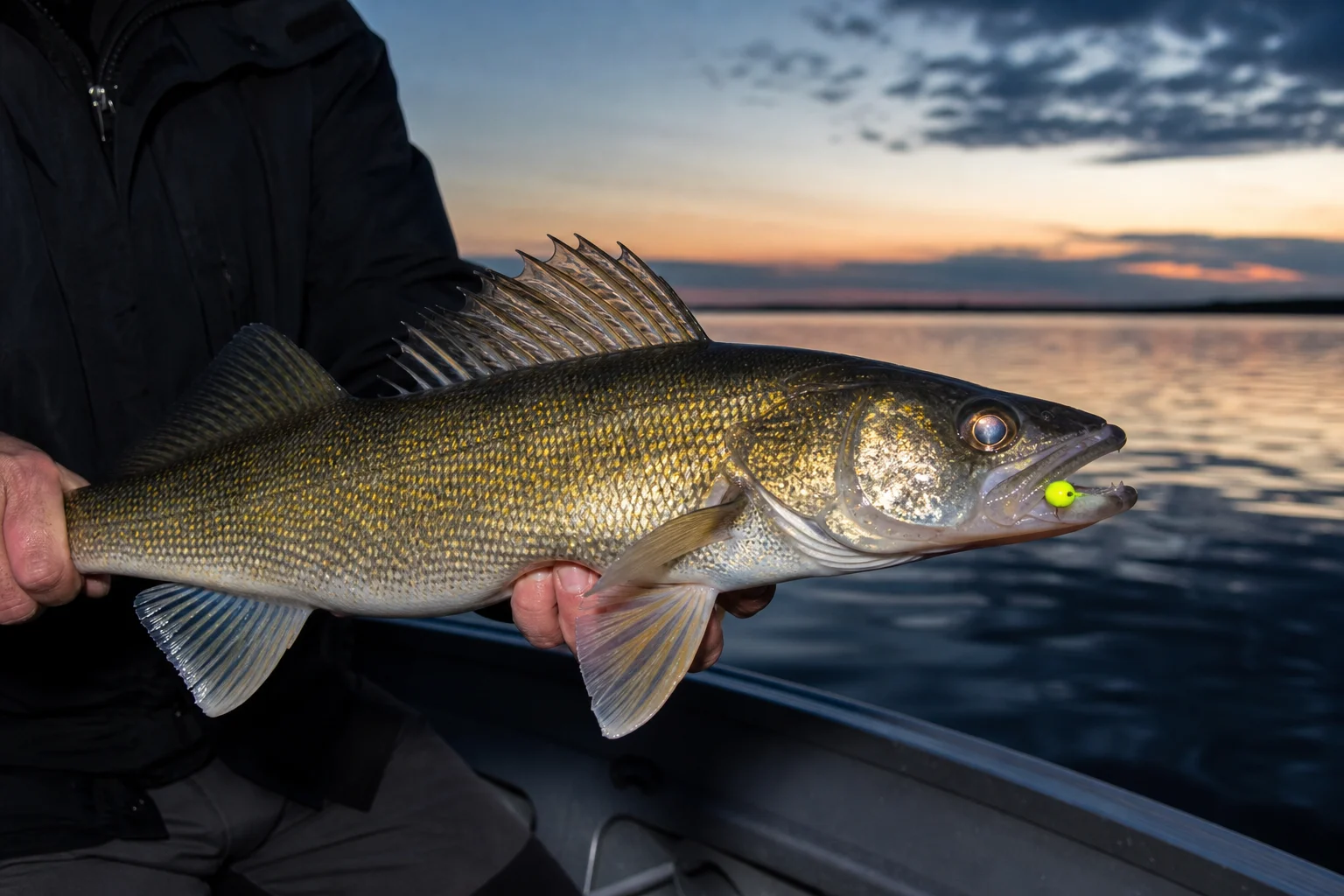
Scenting Jigs And Live Bait For Walleye And Crappie
Walleye and crappie inspect before they commit, and they feed hardest in low light. That makes scent far more useful than it is for reaction-strike species. Here is how to treat jigs, hair, tubes, minnows and crawler harnesses.
Walleye and crappie share a habit that makes them very different from bass: they are inspectors. Neither fish reliably crushes a bait out of aggression. They ease up, look, and take it softly — often so softly that the only sign is a line that stops falling or a rod tip that loads a quarter of an inch.
Add the water these fish live in — low light, deep basins, stained rivers, night bites under lights — and you have a category of fishing where chemical senses carry a lot of the load. Scent is not a marginal edge here. It is one of the more practical adjustments available.
Why It Matters More Than It Does For Bass
Three things stack up.
They eat in low light. Walleye are built for dim conditions and feed hardest at dawn, dusk and after dark. Crappie stack in deep brush and around lights at night. When sight contributes less, smell and taste contribute more.
They eat softly. A walleye often takes a jig and swims toward you. A crappie inhales and holds. Neither gives you the violent thump that makes hookset timing easy. A bait that tastes right buys you the extra beat you need to feel the bite and react.
Presentations are slow. Vertical jigging, slip-bobbers, lindy rigs, dead-sticked minnows, slow-trolled crawler harnesses — all of it is measured in inches per second. Slow baits give scent time to matter, which fast baits never do.
Walleye — Rigging And Application
Jig and minnow
The most productive combination in walleye fishing, and the easiest to improve. The minnow already smells like food, so scent's job is to extend and amplify rather than replace.
- Treat the jig head and the collar before you hook the minnow. Product pools in the collar and at the hook eye, where it stays put instead of washing off.
- Give the minnow itself a light coat, especially once it has been in the water long enough to look tired. A dying minnow can still fish well if it keeps signalling.
- Re-treat every drop when jigging vertically in current. River current strips a bait quickly.
Plastics on a jig
Ringworms, paddle tails and twister tails have exactly the texture that holds scent. Roll them through a small amount before rigging so the ribs are loaded, and re-treat every ten drops or so. In stained river water this is one of the highest-value habits in walleye fishing.
Crawler harnesses and slow trolling
A nightcrawler on a spinner rig moving at 1 mph is close to an ideal scent scenario — slow enough to leave a trail, long enough in the strike zone to be found. Treat the crawler and the beads ahead of it. Re-treat every time you check for weeds, which you should be doing anyway.
Blade baits and jigging spoons
Hard metal sheds product fast. Target the split rings and treble shanks, and if the spoon has a dressed hook, load the dressing. On a vertical jigging spoon worked with long pauses, this matters more than the smooth-body case would suggest — the bait is hanging still in front of a fish that is deciding.
Crappie And Panfish
Hair and marabou jigs
The single best scent carrier in panfish fishing. Marabou and bucktail wick product and hold it far longer than a plastic body will, and they release it slowly as the fibers breathe. Work a small amount into the base of the fibers, not just the tips.
If you fish a hair jig under a slip float over brush, you have built close to the perfect scent presentation: a bait that is essentially motionless, in cover, in front of fish that inspect before eating.
Soft plastic tubes and micro plastics
Tubes are hollow — that is free storage. Put a small amount inside the tube body before you insert the jig head, and it seeps out through the skirt strands over a long stretch of fishing. Very few crappie anglers do this, and it works.
Minnows under a float
A live minnow suspended over brush is a waiting game measured in minutes. Treat the hook shank and give the minnow a light coat when you rebait. On a night bite under lights, where crappie are cruising and inspecting, it is a genuine edge.
Bluegill and perch
Small baits, small mouths, lots of pecking. Scent helps mainly by turning a peck into a commit. A light treatment on a micro plastic or a piece of crawler keeps fish chewing rather than testing and leaving.
Ice Fishing
Cold water slows chemical dispersion, so the trail is smaller — but everything else about ice fishing favors scent. Baits hang nearly motionless, fish approach slowly and hover, and you can watch the whole interrogation on a flasher or camera.
Treat the jig, treat the wax worm or minnow head, and re-treat every time you pull up to check. The classic ice pattern is a fish that rises, sits under the bait, and then either commits or fades. Scent is one of the few things you control in that moment.
Reapplication Timing
- Vertical jigging in river current: every drop or two.
- Vertical jigging in a still basin: every 5 to 10 drops.
- Slip float and dead-stick: every rebait and every 15 to 20 minutes of soak.
- Trolling crawler harnesses: every weed check.
- Ice fishing: every time the bait comes up the hole.
- Always: after a fish, after a snag, and after you handle fuel, food or sunscreen.
What To Look For In A Product
For this style of fishing, two properties matter most.
It has to cling. Vertical presentations mean the bait is in the water continuously rather than in the air between casts, so a thin liquid dilutes off quickly. A gel that bonds to the bait keeps working through a long soak.
It has to be genuinely all-species. A walleye trip produces crappie, perch, white bass and the occasional catfish. Carrying one bottle that covers all of it beats sorting through four.
Legacy Strike 75 is built for exactly that — an all-natural cling gel on a 75-year-old trigger formula, one bottle across every species in fresh and salt water.
The Takeaway
Walleye and crappie fishing rewards patience and small refinements. Scent is one of the smallest adjustments available and one of the few that works in the exact moment the fish is deciding — motionless bait, low light, soft take.
Treat the jig head, load the hair, fill the tube, and re-treat far more often than feels necessary. For the fuller technique breakdown see how to use fish attractant on every lure you own.
Written by Legacy Strike 75